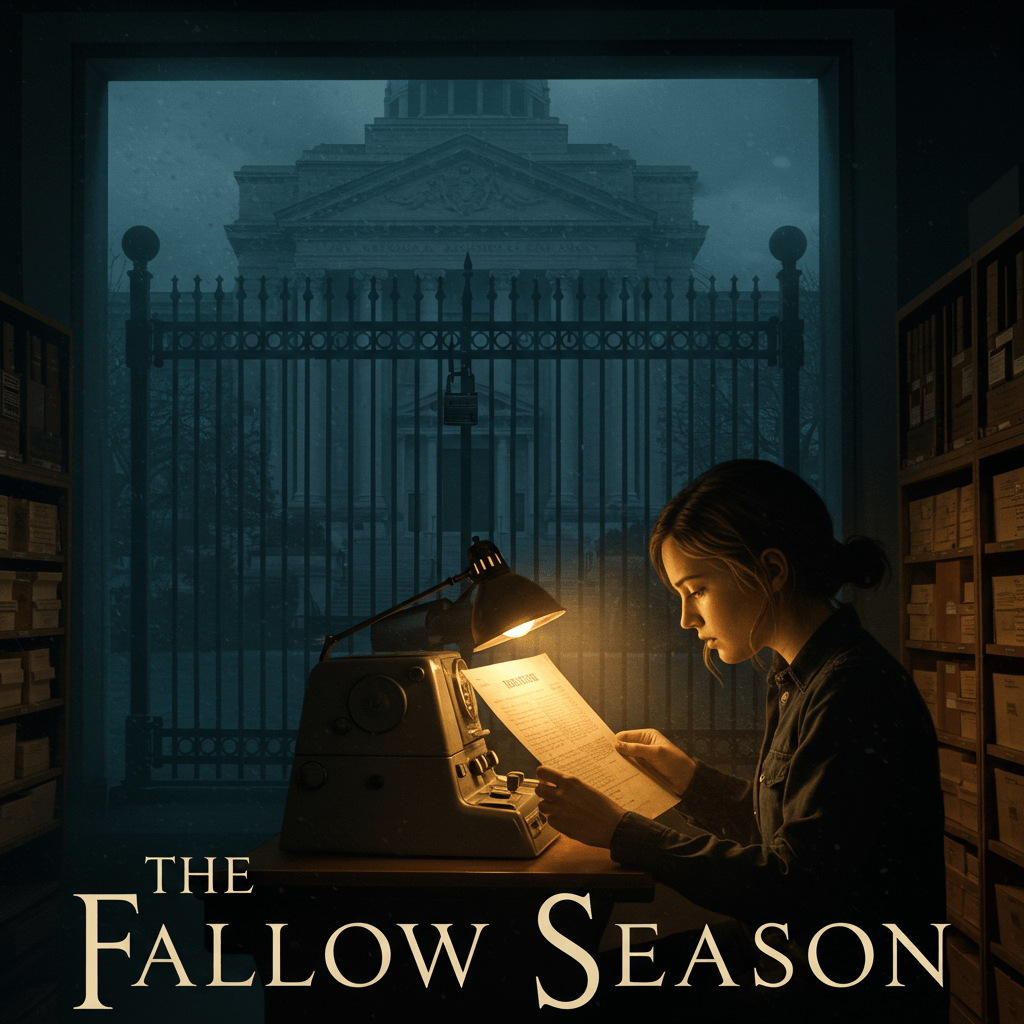
The locked door of the National Archives Annex was a mirror this morning. Elara didn’t see her own reflection, not really, just a distorted, gray smudge of a woman holding a lukewarm latte, framed by the wrought-iron fence. It wasn’t the institutional architecture that felt cold; it was the sheer bureaucratic silence.
The shutdown had begun with the usual political spectacle: a blustering headline, a quick, angry vote, and then the slow, creeping paralysis. For the first few days, the impact had been theoretical, a distant, televised annoyance. Elara, a freelance historical consultant specializing in early 20th-century municipal records, had joked about catching up on her reading. Now, two weeks in, the joke had curdled.
Her contract with the City Museum was dead in the water, drowning in the stagnant pool of inaccessible information. She needed the digitized building permits from 1904—data locked away on a server in this building, guarded by people who weren’t being paid to let her in.
She knew she was lucky. The ache in her bank account was a dull throb, not the sharp, existential panic of true hunger. She had savings. She wasn’t one of the security guards—people like Mr. Chen, whose quiet efficiency she had always admired, a man who clocked in every morning before dawn. She had seen him yesterday, standing outside the annex, not in uniform, just staring at the closed gates with a defeated slump to his shoulders.
She had tried to offer him coffee. “You shouldn’t be here, Mr. Chen,” she’d said.
He hadn’t looked at her, his eyes fixed on the empty guard booth. “Habit, Ms. Elara. And I check the news. Every day, I check. Hoping they’ve finished their nonsense.”
Nonsense. That was the word, simple and damning. The livelihoods of hundreds of thousands of people—the food on their tables, the heat in their homes, the medicine in their cabinets—were suspended over what both sides insisted was a matter of principle.
She thought of the archival documents she was trying to access. They detailed the construction of the old city hospital, a testament to a time when civic works, no matter how contentious, eventually got built. People argued, yes, but they ultimately laid bricks. They funded the project. They finished the roof. The work of the nation continued.
Now, it felt like the entire edifice was stuck in a perpetual disagreement over the color of the mortar.
Elara leaned against the fence, the cold metal seeping through her jacket. Her inability to work—the “significant effect” on her scope of work—was frustrating, but it was nothing compared to the quiet, dignified terror in Mr. Chen’s eyes. Her professional anxiety was a secondary effect; his was the direct, deliberate wound inflicted by the political class.
A pigeon landed on the sign listing the now-obsolete visitor hours. She finished her cooling coffee and crushed the cup, her anger a small, clean knot in her chest. She wished for a political miracle, a burst of sanity that would make both sides realize the real cost of their power struggle wasn’t measured in budget deficits, but in the lost wages of a security guard, the stalled careers of citizens, and the sheer, unforgivable waste of the country’s time.
The archives were closed, the city museum was waiting, and Elara had nothing to do but wish for the adults in the room to finally agree on the simplest, most essential thing: to work.
The air in the small apartment was thick with the scent of fermented fish and lemongrass, a fragrance that was, for me, the very essence of home. It was the smell of mohinga, a dish my late grandmother used to cook most Sundays in Yangon, a dish that tasted like a warm hug and the promise of a good day. As I stirred the catfish broth, the memory of her came to me—her laughter like a string of bells, her hands gnarled but quick as she prepared the noodles and garnishes.
The taste of a world beyond Burma came in a small teashop, not from a cup, but from a plate of laphet thoke, a salad of fermented tea leaves that danced on the tongue with a mix of sour, bitter, and nutty flavors. It was a chaotic mix, much like my life at the time, filled with the crunch of roasted peanuts, the pop of crispy beans, and the sharpness of tomatoes. It was a dish that taught me to embrace complexity and find beauty in the chaos.
Singapore was a different world. The heat was a living thing, and the food was an education. I learned to love the simple perfection of chicken rice, the tender meat, the fragrant rice, and the fiery chili sauce. It was a dish that spoke of efficiency and comfort, a quick, delicious meal that fueled a city always on the move. It was the antithesis of the leisurely Burmese meals I was used to, but no less satisfying.
And then came the nights of mala xiang guo, a dish that felt like a culinary rebellion. A stir-fried pot of whatever you desired, drenched in a spicy, numbing sauce that made your lips tingle and your eyes water. It was a dish for friends, for sharing, for daring each other to take one more bite. It was a testament to the city’s melting pot of cultures, a dish that was both a challenge and a reward.
But no matter where I traveled, no matter what new flavors I discovered, my heart always returned to the fiery, sour comfort of Tom yum and the rich, creamy warmth of green curry. These Thai dishes, with their perfect balance of sweet, sour, salty, and spicy, felt like a bridge between the different parts of my life. The Tom yam, with its floating galangal and chili, was a taste of adventure, while the green curry, with its tender bamboo shoots and creamy coconut milk, was a taste of comfort.
Each dish was a chapter in my life’s story, a memory etched in my mind and on my taste buds. From the humble Mohinga of my childhood to the fiery Mala Xiang Guo of my adulthood, my plate has always been a map of my journey, a delicious reminder of where I’ve been and who I’ve become.
The humid air of Changi Airport always hit me first, a thick, warm blanket that smelled of rain and orchids. After a decade in Singapore, I had grown used to the predictable hum of life in a city where rules were clear and security was a given. We never worried about the things I now found myself worrying about on the U.S. mainland.
In Singapore, the concept of a gun was an abstract one, confined to police officers and soldiers. It was something you saw in movies, not in the supermarket parking lot. The laws were simple and unyielding: private citizens weren’t allowed to own firearms. The punishments for doing so were severe, designed to deter even the thought of it. We lived with a deep-seated sense of communal safety, a feeling that the government had a firm hand on the tiller of our collective well-being. This extended to our freedoms, too. While we knew our conversations and public statements were subject to more scrutiny than in the West, we accepted it as a trade-off for the stability and harmony of our diverse society.
The move to the United States was a jarring shift. The first time I saw a news report about a mass shooting, I felt a knot of dread. In Singapore, such an event was practically unthinkable. The U.S. embraced a different kind of freedom, one that was enshrined in its very Constitution. The Second Amendment was a phrase I’d read about but never truly understood until I lived there. It wasn’t just a legal text; it was a deeply personal belief for many Americans, a conviction that the right to bear arms was a fundamental part of self-defense and liberty. This freedom felt expansive, but it also carried a weight of responsibility and a constant undercurrent of risk.
But then I moved to Hawaii. Here, the air smells of plumeria and salt, and there’s a different kind of safety in the atmosphere. It’s the Aloha spirit—a cultural philosophy that emphasizes kindness, compassion, and a shared sense of community. The gun laws are stricter than in many other states, but it feels like more than just legislation. There’s a palpable sense of peace that seems to reduce the need for violence. While the U.S. mainland grapples with the fallout of its gun culture, Hawaii offers a quieter, more harmonious alternative, a pocket of peace that feels closer in spirit to my life in Singapore, yet still fundamentally American.
Now, living in America, I find myself navigating these three worlds in my head. I miss the quiet, predictable security of my life in Singapore. I wrestle with the complex and sometimes-perilous ideals of the mainland U.S. But in Hawaii, I’ve found a unique balance—the freedom of America tempered by a spirit of aloha that prioritizes communal harmony over individual aggression. It’s a life of constant negotiation—between the comfort of collective order and the sometimes-perilous thrill of individual liberty, all now viewed through a lens of island tranquility.
It’s funny how the things we do to relax change over time. When I was younger, my downtime was all about escaping into other worlds, whether I was navigating a digital landscape in a video game or getting lost in a good book. I’d spend hours immersed in stories and challenges, finding a quiet satisfaction in the thrill of a new adventure.
As I grew a little older, my escape evolved. I started spending more time watching movies. The shift was subtle, but I was still in the role of a consumer, soaking up the creative work of others. It was a comfortable phase, a way to unwind and be entertained without having to do much. My hobbies were all about taking things in, absorbing information and stories without the pressure of creating anything myself.
But lately, something has shifted again. My relaxation isn’t just about escape anymore; it’s about expression. Now, my favorite way to decompress is sitting down here, on my WordPress blog, to write.
I’ve discovered that writing is a unique form of relaxation. It’s a chance to take all those experiences I’ve had—from the games I’ve played to the books I’ve read and the movies I’ve watched—and use them to shape my own thoughts. The simple act of putting my opinions and views into words feels like a release. It’s no longer about escaping into someone else’s world; it’s about building my own.
I’m still learning, of course, but there’s a certain peace in the process. It’s a quiet, reflective space where I can process my personal experiences and share them with others. I’ve found that the simple act of writing a post, hitting publish, and knowing that my words might connect with someone else is more rewarding than any game I’ve ever played. This blog has become my new favorite way to relax, a space where I can not only be myself but also share a piece of who I am with the world.
Yangon in the 1980s was a city of forgotten grandeur and faded hope, but to a child born into it, it was simply the world. The humid air hung thick with the smell of jasmine and vehicle exhaust, a constant presence that was as much a part of the city as the crumbling colonial buildings and the golden shimmer of the Shwedagon Pagoda. My world, however, was much smaller. It was the tight-knit streets of our neighborhood, the laughter echoing in the courtyard, and the quiet, urgent whispers of the adults.
I was born under the long, unyielding shadow of dictator Ne Win. The Burmese Socialist Party, or BSP, controlled everything. My parents, like everyone else, navigated a life of endless queues for rice, the sudden disappearances of neighbors, and the pervasive sense that every word spoken might be overheard. As a child, I didn’t understand the meaning of “one-party rule” or “socialist government.” The concepts were too abstract, too grand. The words I knew were simpler: “school,” “food,” “play.” The world of politics was a closed book, a collection of vague anxieties that flitted across my parents’ faces. I saw their fatigue, but I didn’t know the source. The world felt quiet, a stagnant pond where nothing ever seemed to change, yet the tension was always there, just beneath the surface.
Chapter 2: The 8888 Revolution
The silence didn’t last. One day, the whispers turned into a roar. I was in kindergarten, a time meant for learning simple songs and the alphabet, when the 8888 revolution began. I don’t remember the details like an adult would, but the fragmented memories are burned into my mind. I remember my late grandmother pulling me close, her face a mask of worry. I remember the sounds of shouting from the streets, the distant wail of sirens. The world outside the classroom, once a blur of safe routine, was now a violent, unpredictable storm.
The BSP government, once an unmovable fixture, collapsed. The man who had been a distant, frightening name—Ne Win—was gone. But the fear didn’t dissipate. Instead, it sharpened into something more defined, more immediate. The military junta took control, and the new face of power was Saw Maung. He was a stern, unsmiling figure who spoke of order and stability, but his promises felt hollow. The world outside the window of our home had changed completely, and though I was still too young to understand the complex power dynamics, I felt the new coldness that had settled over the country.
Chapter 3: Than Shwe’s Grip
Saw Maung was a temporary figure, a place-holder for a far more formidable mind. He was succeeded by Than Shwe, a man my parents spoke of in hushed, reverent tones of fear. “Cunning and a mastermind,” they would say, and for decades, he proved them right. He ruled with a chilling efficiency, a master of psychological warfare who knew how to twist a nation’s soul.
As I grew, so did my understanding. The political world was no longer a vague shadow; it was a cage. I saw how Than Shwe’s regime controlled every aspect of life. Information was a carefully filtered stream, and dissent was a death sentence. The city was under a constant watch, and the vibrant life I remembered from my childhood seemed to have been replaced by a pervasive sense of caution. This was the world of my youth, a reality shaped by a man who seemed to have no weaknesses, a man who saw everything and felt nothing.
Chapter 4: The Cruelest One
Now, the country is under the rule of Min Aung Hlaing. He is a different kind of dictator, cruel but also, as you said, “the most stupid one.” His brutality feels less calculated and more impulsive, a raw violence that is harder to predict. The decades of Than Shwe’s cunning have been replaced by a more direct, merciless force. It is a new chapter in the same old story, but the cruelty has reached a new peak, and the future feels more uncertain than ever before.
Chapter 5: A Different World
In Yangon, life was a series of improvisations. The most constant variable was the absence of electricity. Our days were dictated by the power schedule, a fickle, unpredictable thing that could disappear without warning for hours. Studying by candlelight became a normal ritual. The ever-present darkness after sunset was a blanket that settled over the city, a quiet reminder of how little control we had.
The world was not just dim; it was also tightly controlled. Foreign currency was a dangerous whisper, something you acquired and exchanged with the utmost secrecy, always with the understanding that you were being watched. A brand-new car was a phantom dream, an object of desire reserved only for those with ties to the military generals. For everyone else, it was a piece of the world they would never touch. And a cell phone, a small black brick of technology, was not just a convenience—it was a privilege, a symbol of immense wealth and influence.
My first trip overseas, to Singapore, was a shock to my system. Stepping out of the airport felt like walking into a different reality. The air was cool and crisp with air conditioning, and the streetlights hummed with a reliable, continuous energy. The city was a monument to modernization, a world where the lights never went out. It was a place of impossible order and efficiency, a stark contrast to the beautiful, chaotic country I had left behind. While limitations still existed, and life wasn’t without its challenges, there was an undeniable sense that the government here cared for its people. It was a strange, disorienting feeling to see a city function so smoothly, to realize that the struggles I had taken for granted were not, in fact, the universal condition.
Chapter 6: Sand, Sea, and Salubrious Air
A decade passed in Singapore. The shock of my arrival slowly wore off, replaced by the quiet hum of a new routine. I learned to navigate the city’s clean streets and predictable systems, and the anxieties of my youth became distant, fading memories. Singapore was a safe harbor, a place to rebuild and breathe, but a part of me always felt like a guest, an outsider looking in. The order, while a comfort, sometimes felt like a cage of its own—neatly arranged and well-maintained, but a cage nonetheless.
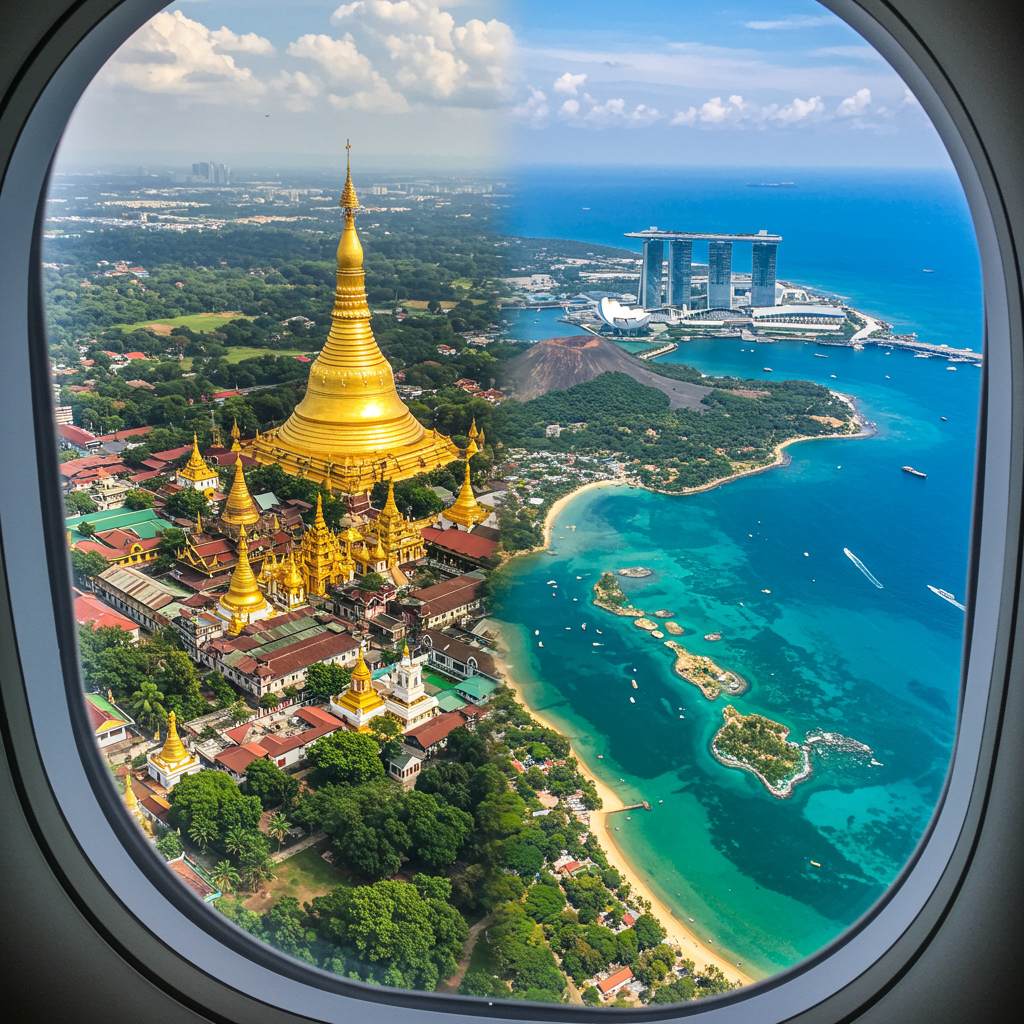
So, after a decade, I left again. This time, my destination was an island of a different kind: Hawaii. I flew over the vast, shimmering Pacific Ocean, leaving behind the gleaming skyscrapers for something more elemental. The moment the plane descended, I felt the difference. The air that rushed in was warm and gentle, carrying the clean, wet scent of the sea mixed with the faint, floral sweetness of an unknown flower. It was “salubrious,” as you said, a word that felt too clinical for the feeling it inspired.
The sand was soft beneath my feet, the sea a hundred shades of blue, and the palm trees swayed with a casual grace that I had never seen before. The constant vigilance I had been taught as a child, and the rigid order I had grown accustomed to in Singapore, seemed to melt away in the face of such raw, untamed beauty. Here, the world felt open, not controlled. It was a place of vast horizons, and for the first time in my life, I started to believe that my own horizon could be just as vast.
The halls of the medical college were a labyrinth of ambition and exhaustion, where days blurred into nights and caffeine was a primary food group. That’s where our story began, in our fourth year, when the weight of our future careers settled upon our shoulders. We were two young students, navigating the relentless demands of the pathology lab and late-night study sessions. For three years, our relationship grew steadily, woven into the fabric of our demanding careers. We learned to rely on each other for support, for a moment of peace in the storm, and for a profound, unspoken understanding that no one else could provide. It was a love built not on grand gestures, but on shared notes, quick meals together, and the knowledge that someone was always in your corner.
Then came the miles. Four years of them. A different country, a different continent, and a time difference so vast it felt like we were living in separate worlds. Our days were a patchwork of missed calls and delayed messages. We clung to brief, often-choppy video chats, trying to piece together each other’s lives from blurry pixels. It wasn’t just the distance that was hard; it was the misunderstandings. A tired tone misinterpreted, a delayed response that felt like a deliberate silence. Friends questioned our sanity, and sometimes, in the depths of our loneliness, we questioned it too. The love we had built on proximity was now being tested by an abyss. The story wasn’t easy, and there were moments when it felt like we were on the verge of letting go.
But the foundation we had built in those college halls was strong, forged in mutual understanding and fortified with unwavering patience. We made it through, knowing that the other person wasn’t a world away, but simply in a different time zone, fighting their own battles. We finally bridged the gap, married, and for a few blissful years, had the luxury of waking up in the same country, the same time, the same bed. We had survived the distance, and we thought we had faced our greatest test.
Then, the world stopped. The pandemic hit, and we were separated again. Two more years of thousands of miles, of different continents, of a quiet ache in our chests. This time, it was different. We were no longer young students, but married partners, and the pain of separation felt sharper. Some people, seeing us apart for so long, might have thought our story was reaching its inevitable conclusion. But we had a secret weapon, one forged in the crucible of our first separation: a profound empathy and a deeper well of patience. We had already proven our resilience. We clung to the belief that this, too, would pass.
And it did. We finally reunited, older, wiser, and more certain than ever that our love was built to withstand any storm. This year, we celebrated our twelfth wedding anniversary, a decade built on a love that survived two great separations, a thousand miles, and an endless stream of challenges. It’s a testament to the fact that love isn’t about being in the same place at the same time, but about understanding that the other person, no matter where they are, is your home.
The dust of the Yangon streets settled on Moe’s worn canvas shoes, a familiar, ochre-colored patina that coated everything in the city. He walked with a determined purpose, his head down against the afternoon sun, past the fading colonial-era buildings and the ever-present, watchful eyes of a society held in a silent, collective breath. This was his world, the only one he had ever known—a world defined by the quiet hum of a military dictatorship, a low-frequency hum that vibrated through every interaction, every aspiration.
In this climate, dreams were not loud declarations; they were whispered ambitions, nurtured in the sanctuary of family homes and dimly lit study rooms. For Moe, the dream was medicine. It was a tangible, noble goal, a way to build something constructive in a world that often felt defined by its restrictions. He spent his youth buried in textbooks, the dense weight of medical knowledge a welcome contrast to the oppressive lightness of the air outside. The path was rigorous, a narrow, uphill climb, but the discipline forged in him a resilience that would serve him for a lifetime.
When the acceptance letter from the University of Medicine 1 Yangon arrived, it wasn’t a moment of explosive celebration but of profound, quiet relief. The years at university were a testament to his single-minded focus. He navigated the demanding curriculum, the long nights of study, and the intricate dance of hierarchy with a grace born of necessity. Graduation was not just an academic achievement; it was a passport, a key to a new life. He stood on the precipice of a future that felt both exhilarating and terrifyingly unknown. The country that had shaped him now felt too small to contain his ambition, and he looked out toward a new horizon.
Singapore was a different universe entirely. The transition was jarring, a sensory overload of modernity and efficiency. The moment he stepped out of Changi Airport, the air, cool and conditioned, felt like a promise. Gleaming skyscrapers pierced a perpetually humid sky, and the streets, immaculately clean, were a blur of motion. It was a city that moved at the speed of light, a stark contrast to the languid, dusty rhythm of Yangon. Moe, with his new student visa and a heart full of cautious optimism, felt like a ghost haunting the future.
The first year was a whirlwind of academic rigor and cultural assimilation. He absorbed the hyper-efficient work culture, the pragmatic directness of the people, and the dizzying array of cultures coexisting in a single, compact space. He found a job, and that one year stretched into a decade. He found a rhythm, a routine, a semblance of belonging. He worked diligently, climbing the professional ladder with the same quiet determination that had defined his youth. He learned to navigate the complex social landscape, to understand the subtle nuances of communication, and to appreciate the city’s relentless pursuit of excellence.
Yet, as the years passed, a subtle fissure began to appear in the perfect façade. It wasn’t an overt animosity, not a shouted slur or a blatant act of exclusion. It was something far more insidious. It was the promotion that went to a less-experienced local colleague. It was the casual question at a dinner party, “When are you going back home?” It was the knowing look when he was passed over for a leadership position, despite his undeniable qualifications and hard work. It was a thousand small cuts, a quiet discrimination woven into the fabric of the work culture. It was the feeling of being forever a guest, an outsider in a gilded cage.
He was a cog in the machine, a valuable one, but a temporary one. He contributed, he excelled, but the glass ceiling was made not of glass, but of a quiet, polite sense of otherness. It was a heavy realization, a weight that settled on his shoulders, making the city’s blinding lights feel less like a welcome and more like a spotlight on his foreignness. He had built a life, but he hadn’t built a home. The decade in Singapore, for all its professional success, had left him with a deep, unsettling ache for a place where he could simply be.
The call from Honolulu felt like a breath of fresh air, a whisper of a different kind of life. It was a job offer, a professional opportunity to build on everything he had learned, but it was also a chance to escape the quiet tension of his existence in Singapore. The move was bittersweet. He was leaving behind the city that had given him so much, that had transformed him from a young man into a seasoned professional, but he was also leaving behind the subtle, gnawing feeling of never quite fitting in.
Honolulu was everything Singapore was not. The frantic energy of the metropolis was replaced by the soothing rhythm of the ocean. The gray and glass of the city were replaced by the vibrant greens of the mountains and the endless blue of the Pacific. The air smelled of plumeria and saltwater, and the people, a vibrant tapestry of cultures, moved with an easy, unhurried grace. Here, the idea of being a foreigner felt different. Everyone, in some way, had come from somewhere else, and the diversity was a source of connection, not a cause for division.
Moe found his footing quickly. The work was challenging and rewarding, but the life outside of work was what truly transformed him. He learned to surf, to hike the lush trails, and to appreciate the simple beauty of a sunset over the water. The decades of his life, from the quiet oppression of Yangon to the subtle discrimination of Singapore, had taught him resilience, patience, and the ability to adapt. But it was in Honolulu that he finally learned what it meant to feel at peace. He wasn’t just a person working a job or a student chasing a dream; he was part of a community, a person living a life. The horizon, once a distant promise, was now his home. The journey was not just a series of moves, but a search for a place where his soul could finally come to rest.





 A New Latitude